The ripple effects of developments in artificial intelligence (AI)– mostly emanating from a limited group of companies outside of Europe and taking place at breakneck speed – continue to spread across the computing ecosystem, with implications for everything from individual careers up to whole industries. As hyperscalers announce massive infrastructure buildouts and AI tools gain increasing functions and autonomy, Europe is left wondering whether it is too late to join the party.
But what if there were another paradigm for next-generation computing? What if this paradigm avoided reliance on massive data centres, with their eyewatering energy demands? What if it facilitated collaboration and the pooling of existing computing resources; eschewed the antisocial incentives of the attention economy and surveillance capitalism while allowing users to harness computing power tailored to their needs; and was based on rightsized infrastructure created in Europe which allowed for flexible, sustainable, resilient operation?
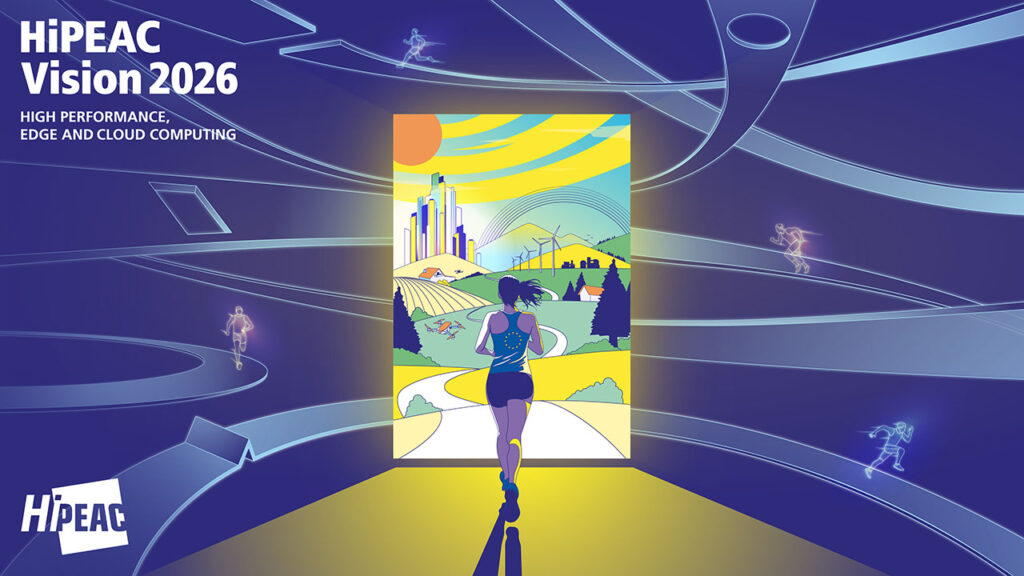
At a time of intense global volatility, the HiPEAC Vision 2026 argues that, rather than blindly copying other countries’ roadmaps, Europe can and should carve out its own path in computing: a trajectory which reflects the European context while supporting the values and culture which are important to European society.
A paradigm for the European context
The core of the HiPEAC Vision 2026 is the ‘next computing paradigm’ (NCP), where computing is distributed on demand rather than systematically requesting cloud resources. In this vision, the future we must design for is not a monolithic intelligence running in a single place; it is a federated fabric of specialized models, tools, and services that cooperate under orchestration. As a step towards the wider NCP, an agentic artificial intelligence infrastructure should be built, whereby agents can be selected according to users’ criteria, including non-functional properties. Flexible, modular hardware – specialized accelerators, memory-centric designs, reconfigurable elements and chiplet platforms – should be developed in Europe to respond to fast-moving compute requirements.
As AI increasingly dominates the design of hardware and software, specification becomes the primary human-owned artefact. This shifts the main bottlenecks to specification, verification (checking that the generated code satisfies the specification) and validation (ensuring that the system’s behaviour in real-world use matches the intended outcome). In this context, development toolchains themselves become strategic infrastructure.
Where safety-critical systems are concerned, traceability, explainability, and independent validation must be preserved even as AI becomes more capable. Europe’s long-standing strengths in rigorous engineering methodologies, certification processes, and regulatory frameworks represent a key opportunity here, and AI can be leveraged to scale well-defined processes.
As for cybersecurity, the rapid integration of AI into both attack and defence is profoundly transforming the field. Addressing this new threat landscape will require secure-by-design AI architectures, robust evaluation methodologies, and new protection mechanisms capable of separating trusted instructions from untrusted inputs. The growing dependence on complex software and hardware supply chains further amplifies cybersecurity risks, which can be combated in part by robustly identifying software components and developing software bills of materials (SBOMs) to track dependencies.
More generally, software and hardware supply chains are central to European digital strategic autonomy. The HiPEAC Vision 2026 recommends a strategic approach to open source a strategic anchor to ensure that key digital services are available to European citizens. Pooling resources to co-develop industrial-grade, European-led open source platforms reduces industry-wide duplication of effort and creates de facto standardization.
Open source can also be a powerful sustainability enabler: mandating open application programming interfaces (APIs) and open source implementations for end-of-life consumer electronics can combat programmed obsolescence and grant functional hardware a virtually indefinite second life. Given the embodied emissions associated with device manufacturing, extending device life is one of the main recommendations of the sustainability chapter, along with establishing standard methodologies for measuring impact through life-cycle assessments and incorporating these metrics into design tools.
What does all this mean for Europe?
With massive technology companies in the US and China at the forefront of AI development, it is natural to feel that Europe cannot compete. On the other hand, in the last decade Europe has developed a competitive high-performance computing (HPC) infrastructure, it has more founders than the US, it has a net brain gain of researchers, and, in 2024, more startups were created in Europe than in the US.
The HiPEAC Vision 2026 advocates for an ambitious target of 100,000 technology-enabled startups per year across Europe, which should be incubated in science and technology clusters. Challenge-based funding instruments similar to DARPA or SPRIN-D, fast and agile, and with clear potential for commercialization, should be used, and ‘invest in Europe’ and ‘buy European’ policies should be promoted.
In conclusion, the HiPEAC Vision 2026 promotes a systems-oriented direction. HiPEAC assumes that impact in the next wave of computing (closely linked to AI) will be delivered by a heterogeneous continuum: specialized services (models) collaborating under orchestration, running across edge, cloud, and everything in between; AI becoming increasingly intertwined with the physical world (hence needing to cope with its constraints); specialized accelerators coexisting with flexible platforms; and memory-centric designs shaping what is feasible outside hyperscale data centres.
Europe can lead here, through the creation of innovation and startups, shared roadmaps, shared tooling, shared benchmarks, shared protocols, and shared infrastructure – aligned with Europe’s strategic autonomy objectives and industrial realities.