Future European Computing Continuum
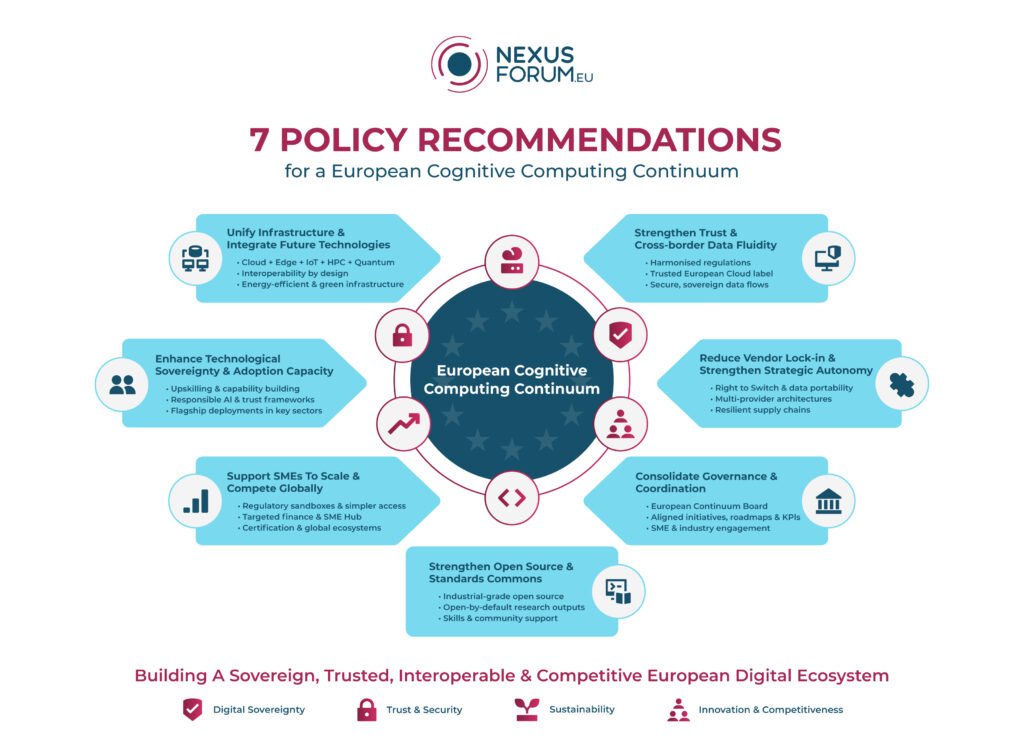
Policy Recommendations for the European Cognitive Computing Continuum
NexusForum.EU Strategic Framework
Based on the SWOT analysis and the consultation regarding the 14 critical gaps identified by the ecosystem, this document proposes a set of strategic policy actions.
These recommendations aim to support the consolidation of a sovereign, competitive and trusted European Cognitive Computing Continuum, building on existing EU initiatives such as IPCEICIS, EUCloudEdgeIoT and Common European Data Spaces
1. Policy Action: Unifying the Fragmented Infrastructure and Integrating Future Technologies
Strategic goal: Build a federated, energyefficient Cognitive Computing Continuum that seamlessly connects cloud, edge, IoT and emerging quantum resources, transforming fragmented infrastructures into a coherent European strategic asset.
Implementation ideas:
- Promote federation by design: Ensure that all EUfunded infrastructure projects (HPC, cloud, edge, networking) are required to adopt a common reference architecture for the European Continuum Fabric, building on IPCEICIS outputs (e.g. SIMPL, related reference architectures) and similar efforts, so that every new deployment is “continuumready” from the outset.
- Continuumready certification and testbeds: Reserve a share of infrastructure budgets for interoperability testing labs and introduce a “ContinuumReady” certification covering APIs, data models and federation services as a prerequisite for EUsupported deployments.
- Establish a hybrid quantum–HPC roadmap: Develop a dedicated policy framework defining interfaces, reference architectures and shared testbeds for integrating quantum accelerators with classical HPC and edge nodes, so that quantum capabilities are embedded into the continuum rather than developed in isolation.
- Establish a quantum–continuum integration testbed: Create shared European laboratories and facilities (building on EuroHPC infrastructure) where quantum accelerators are physically integrated with edgeHPC clusters, enabling researchers and developers to prototype, test and validate hybrid quantumclassical algorithms in a realistic continuum environment. Fund joint governance between quantum computing centres and edgecompute operators to ensure seamless technical integration.
- Photonicsready infrastructure standard: Extend the “ContinuumReady” certification to include photonic (optical) computing architectures alongside quantum and classical HPC, ensuring that emerging photonic accelerators for AI and data processing can be deployed and federated within the continuum without proprietary lock-in.
- Align infrastructure funding with green connectivity objectives: Condition EU and national support for connectivity and datacentres on the deployment of energyefficient fibre and 5G/6G networks explicitly designed to support decentralised edge workloads, and encourage projects that demonstrate measurable improvements in energypercompute through advanced cooling, dynamic power management and the use of renewablepowered data centres.
2. Policy Action: Strengthening Trust and Cross-border Data Fluidity
Strategic goal: Position European cloud–edge–data solutions as the most trusted option globally by facilitating crossborder data use and embedding data sovereignty, security and compliance into the core of the continuum.
Implementation ideas:
- Harmonise the regulatory framework for data spaces: Adopt targeted legislation and guidance that removes conflicting national interpretations of datasharing rules for participation in Common European Data Spaces, accompanied by opensource reference implementations of harmonised dataexchange protocols to enable plugandplay connectivity.
- Develop a “Trusted European Cloud and Edge” label: Build on existing EU work on trusted cloud frameworks to create a tiered label that combines requirements on European ownership and control, insulation from extraterritorial dataaccess laws, robust cybersecurity and alignment with EU dataprotection rules, and promote its uptake in public and private procurement.
- Integrate security and sovereigntybydesign into procurement: Require that publicsector and criticalinfrastructure tenders systematically prioritise solutions with demonstrable datalocalisation options, transparent security assurance and technical reversibility over opaque foreign platforms.
- Support independent audit services: Facilitate EUlevel auditasaservice facilities that certify compliance of cloud and edgebased services with trusted cloud and dataspace requirements, providing readytouse assurance for public buyers and SMEs.
3. Policy Action: Reducing Vendor Lock-in and Strengthening Strategic Autonomy
Strategic goal: Significantly reduce the structural dependence of European SMEs and public bodies on nonEU technology vendors by enforcing interoperability and building a more resilient European hardware and service base.
Implementation ideas:
- Guarantee the right to switch: Provide standard contractual clauses and guidance for public buyers that embed exit strategies, including dataexport formats and open interfaces, and make “right to switch” clauses mandatory in publicly supported cloud and edge contracts to reduce legal and technical lock-in risk.
- Support multiprovider strategies: Offer targeted incentives (such as vouchers or grants) for SMEs and public organisations that adopt multicloud and multiedge architectures, reducing singlevendor exposure and encouraging greater use of European providers.
- Publish multiprovider reference architectures: Develop and promote open multicloud and multiedge blueprints, based for example on container orchestration and open servicemesh technologies and aligned with IPCEICIS reference architectures, to lower the entry barrier for SMEs.
- Reinforce semiconductor and edgeAI resilience: Within the Chips Act and related instruments, prioritise European design and production of lowpower edgeAI and IoT chips, including open architectures such as RISCV, and promote hardware–software codesign so that chip roadmaps are tightly aligned with continuum middleware and applications.
- Increase transparency and resilience in the supply chain: Encourage traceability mechanisms and diversified sourcing for critical components used in continuum infrastructures supported by EU funds, improving risk management for public authorities and industry.
4. Policy Action: Consolidating Governance and Coordination for the Continuum
Strategic goal: Provide coherent strategic governance for the Cognitive Computing Continuum by aligning existing initiatives, improving coordination across instruments and ensuring consistent engagement of industry and SMEs.
Implementation ideas:
- Establish a Continuum Coordination Mechanism: Set up a dedicated governance structure (e.g. a European Continuum Coordination Board) bringing together Member States, industry, SMEs and research actors to steer the implementation of continuum-related policies and programmes and to ensure continuity beyond individual projects.
- Align major strategic initiatives: Ensure strategic and operational alignment between initiatives such as IPCEICIS, GaiaX, IDSA, AIOTI and related partnerships through shared roadmaps, joint KPIs and coordinated work programmes, reducing overlaps and gaps.
- Strengthen SME and user sector participation: Require structured SME and sectoral user involvement (e.g. manufacturing, health, mobility, energy) in the design and evaluation of continuumrelated projects so that policy instruments and infrastructures address real deployment needs.
5. Policy Action: Strengthening the Open Source and Standards Commons
Strategic goal: Turn Europe’s opensource and standards assets into a robust commons that underpins digital sovereignty and accelerates innovation across the continuum.
Implementation ideas:
- Create a sovereign opensource and standards facility: Set up a dedicated facility to ensure long-term maintenance, security hardening and industry-grade evolution of critical opensource components and open standards that underpin the continuum (such as orchestration frameworks, dataspace connectors and reference implementations).
- Promote open-by-default research outputs: Require that software, reference architectures and core libraries developed with EU R&I funding for the continuum be made available under suitable open licences, accompanied by documentation and governance models that facilitate industrial uptake.
- Encourage industry participation in the open commons: Design incentives (for example recognition schemes, co-funding or joint development programmes) for large companies and SMEs to contribute to and adopt opensource and open standards solutions supporting the continuum.
- Support skills for open source: Promote training and capacity building programmes that enable developers, integrators and public administrations to effectively use and contribute to opensource technologies relevant for the continuum.
6. Policy Action: Supporting SMEs to Scale and Compete Globally
Strategic goal: Remove regulatory and financial barriers that prevent European deeptech SMEs from scaling in the continuum, and enhance their participation in global digital ecosystems and value chains.
Implementation ideas:
- Deploy continuum-focussed regulatory sandboxes: Establish cross-border sandboxes where SMEs can test cloud-edge-IoT-AI solutions and data spaces under simplified, supervised regulatory conditions, facilitating compliance with the AI Act, data protection and sector-specific rules.
- Strengthen scale-up finance for cognitive technologies: Develop targeted financial instruments (for example blended finance schemes, growth funds or guarantees) dedicated to capital-intensive continuum technologies, reducing early dependence on foreign investment and acquisitions.
- AIready SME certification programme: Establish a tiered certification scheme that recognizes SMEs and startups developing opensource AI stack components, reference implementations or continuum-native solutions. Certified SMEs receive priority access to EU funding (Horizon, Digital Europe Programme), preferential scoring in public procurement tenders and visibility in a searchable “European AI Tech Register”, creating a market advantage for openstack contributors.
- European AI Venture Fund: Create a dedicated venture capital instrument managed by the European Investment Fund (EIF) specifically for deeptech AI/ML and advanced computing startups (not just generic “cognitive tech”).
- Facilitate SME participation in global ecosystems: Support SMEs and research actors in engaging with international standardisation bodies and global innovation networks (such as ISO, IEC, IEEE or relevant ope ntechnology foundations), ensuring that European continuum architectures and protocols are represented and adopted.
- Provide a one-stop support interface: Create a “Continuum SME Hub” offering guidance on regulation, funding opportunities, standardisation and internationalisation for companies developing or deploying continuum solutions.
7. Policy Action: Enhancing Technological Sovereignty and Adoption Capacity
Strategic goal: Increase Europe’s capacity to develop, adopt and govern advanced technologies across the continuum, while reinforcing trust in AI and data-driven solutions.
Implementation ideas:
- Strengthen skills and capability building: Support training and upskilling programmes for public administrations, SMEs and industrial sectors on cloud-edge-IoT-AI technologies, data spaces and opensource tools relevant to the continuum.
- Promote reference implementations and flagship deployments: Fund demonstrator projects in key sectors (such as manufacturing, health, mobility, energy and smart cities) that showcase sovereign, interoperable continuum solutions and can be replicated across Member States.
- Support responsible AI and trust frameworks: Encourage the integration of AI safety, ethics and transparency frameworks into continuum deployments, building on ongoing European and international work on trustworthy AI to foster user trust and acceptance.
SWOT Analysis and Factors
This section presents the results of a comprehensive SWOT analysis conducted to assess the European Union’s position in advancing technological sovereignty through the convergence of Edge, Cloud, and IoT technologies. Building on the six key factors identified in Deliverable D3.1, Technology, Innovation and Research Capabilities (F1), Framework Conditions (F2), Enabling Conditions (F3), Infrastructures and Connectivity (F4), Collaboration and Engagement (F5), and Industry Participation (F6), this analysis evaluates the EU’s internal strengths and weaknesses, as well as external opportunities and threats, across each domain.
The SWOT analysis was developed through a co-creative process involving project partners, experts, and policymakers, combining desk research with insights from the NexusForum.EU events and working sessions. Drawing on key reports it identifies strategic priorities, vulnerabilities, and opportunities to strengthen EU digital resilience.
Factors
FACTOR 1: TECHNOLOGY, INNOVATION AND RESEARCH CAPABILITIES
European technological capabilities that are relevant to the development of Europe’s Cognitive Computing Continuum and that are needed to meet research & innovation challenges. Scientific knowledge and European technological sovereignty and competitiveness in technologies relevant to the Cognitive Computing Continuum will be increased by the identification of current gaps between research challenges and technological capabilities in the Cognitive Computing Continuum.
Objective: Identifying current gaps between research challenges and technological capabilities in the Cognitive Computing Continuum.
S
- Diverse and Advanced related Technologies.
- Strong Telecommunications Equipment/ Infrastructure Suppliers
- Chip Manufacturing: the Chips Act and RISC-V (open-source hardware architecture) promote technological sovereignty in this field.
- Own Aerospace Sector (Satellites) as a Niche Market and driver of innovation to other sectors.
W
- Slow adoption of advanced technologies in the market.
- Lack of Trust in AI and Data security and quality.
- Lack of availability of research teams with skills and capabilities in open-source technologies and standardization.
- Non-EU technological leaders in the markets and unicorns moving to the US weaken the local technological ecosystem.
- 5.Lack of Investment in R&D in the ICT sector.
O
- Promote Open Hardware Initiatives e.g. European Chip Sovereignty, HW Sovereignty.
- “Federated continuum”. Develop a Federated Technologies Ecosystem to Integrate and Optimize Dispersed Resources.
- Revise Research Investment and Horizon Europe Structure: broader calls, take higher risks.
- Clarify net neutrality rules to support innovative technologies like 5G network slicing.
- Coordinate technical standards at the EU level to support network APIs, edge computing, and IoT deployment.
- Potential to drive innovation in various sectors.
T
- Declining population and loss of competitiveness
- Brain drain and company relocation.
- Global competition.
- Dependence on non-European technologies hinders the EU’s technological sovereignty i.e. automotive industry’s dependence on chips from external suppliers.
- Aggressive strategies of international competitors particularly from the US and Asia.
FACTOR 2: FRAMEWORK CONDITIONS (policies, strategies, plans and regulations)
These are the boundary conditions in the context of a country’s policies, strategies, plans and regulations, and refer to the general circumstances or conditions in which a technology or industry develops.
Objective: Identification of gaps that must be covered to establish the context of the continuum from regulatory and policy aspects.
S
- Europe’s leadership in climate policy and action positions it well to leverage these technologies for sustainable development.
- AI Act sets a framework for ethical AI, balancing technological advancement with societal values.
- European Values build trust and credibility both within Europe and globally: data protection, environmental sustainability, Digital inclusion, cybersecurity, and ethical AI, etc.
- Data Sovereignty: data regulation and protection is a strength in terms of trust and security
- Digital Markets Act promotes Fair Competition supporting smaller companies, startups and consumers.
W
- Absence of a True Capital Markets Union limits the ability to finance large-scale projects in digital technology.
- Insufficient control over compliance with regulations.
- Fragmented and excessive Regulation making it difficult to have a solution that is valid for all EU member states
- Administrative and bureaucratic burden.
- Difficulty Complying with the Cyber Resilience Act in Open Source.
- European Users’ Concerns about trust and use of digital services.
O
- Regulatory Harmonization for a Digital Single Market.
- Expand the EU Chips Act.
- Implement a Long-Term EU Quantum Chips Plan.
- Ensure a unified regulatory framework across the EU by moving towards a single Regulatory Authority.
- Remove Regulatory Barriers to Cross-Border Operations.
- Promote Digital Sovereignty through Projects like IPCEI-CIS.
- Implement EUCS+ certification to boost the cybersecurity and reliability of European cloud services.
T
- Strict regulatory requirements for innovation and AI may slow down progress in critical sectors.
- Privacy and Security Concerns
- Europe is not able to control its energy costs and ownership.
- Lagging Digital Transformation in strategic sectors.
- Failure to Achieve a Single Market.
FACTOR 3: ENABLING CONDITIONS (open source & standards, skills, ethics)
Enabling conditions in the context of technology development refer to the factors that facilitate the successful development, implementation and adoption of a technology.
Objective: Identifying all crucial topics that play a significant role in the development of Europe´s Cognitive Computing Continuum.
S
- The Strength of SMEs in the European Open-Source Ecosystem.
- EC commitment: promoting Open Standards with initiatives such as the European Open Standards Strategy, the European Open Standards Platform and the Digital Single Market.
- Capacity to develop European Talent in Open Source.
- A solid legal Framework Based on European Values.
- A growing awareness and momentum in certain member states that promote and support the implementation of Open Source.
- Good examples of OSS in the public sector.
W
- Education and awareness about Open Source. I.e., shortage of teams capable of maintaining and updating software and hardware.
- EU’s Open-source landscape is fragmented.
- Lack of funding, that can limit the resources available for development, maintenance, and scaling of open-source projects.
- Lack of awareness and understanding of the strategic importance of OS by large companies.
O
- Programs fostering open-source development: Initiatives like StandICT and NGI Common.
- Promote Open Hardware Initiatives addressing maturity level, fragmentation and regulatory challenges is crucial. European Chip, HW Sovereignty.
- EU can attract Open-Source talent by providing a solid legal framework.
- Open-source solutions can meet Ethical and Social Challenges.
- Open- source software (OSS) offers significant potential for sustainability.
T
- Lack of Resources for Maintenance and Scalability.
- Lack of understanding of open source by big companies.
FACTOR 4: INFRASTRUCTURES & CONNECTIVITY
Identifying infrastructure need to enable the European single market for data with the corresponding data spaces and a trustworthy artificial intelligence ecosystem.
Objective: Improved open strategic autonomy in critical data infrastructures along the Continuum.
S
- Diverse and Advanced Technological Infrastructure, supported by initiatives like Gaia-X, Structura-X, and IPCEI projects
- Strong Telecommunications Equipment/ Infrastructure Suppliers
- The Cyber Resilience Act and NIS2 enhance EU digital security, benefiting SMEs by reducing risks and boosting competitiveness.
- Data ownership and data spaces, fostering a unified and collaborative digital market.
W
- SMEs’ reliance on non-EU hyperscalers for their digital infrastructure.
- Europe’s insufficient infrastructure and lack of a unified approach.
- Europe’s high energy costs and limited resources hinder infrastructure development for AI and data centers.
- Europe’s fragmented digital infrastructure and varying investment in 5G/6G and fiber optics hinder the adoption of advanced technologies.
O
- Enhance EU computing and AI by funding infrastructure and connecting nodes.
- Streamline network deployment by consolidating the Gigabit Infrastructure Act to accelerate high-speed digital network rollout.
- Create a common European cloud-edge infrastructure based on openness, interoperability, security, sustainability, and vendor neutrality.
- The integration of AI Factories with HPC is a strategic move to position the EU as a leader in AI innovation.
- Connecting to initiatives such as TEFs- Testing and Experimentation Facilities.
T
- Privacy and Security Concerns.
- Global Geopolitics: Uncertainty Ahead of New US Decisions by the Trump Administration on Cooperation with the EU.
FACTOR 5: COLLABORATION & ENGAGEMENT
Objective: Identify the opportunities to ensure the alignment and active participation of those EU companies directly involved in the IPCEI-CIS and the European Alliance for Industrial Data, Edge and Cloud.
Additionally, identify the opportunities to increase the engagement at international level with research, industry, and users from different domain/sectors interested in the Cognitive Computing Continuum, especially those based in Japan and South Korea (ROK), identifying and evaluating opportunities for strategic alignment with relevant international initiatives.
S
- Initiatives like Sylva, CAMARA, and ApeiroRA foster (multisectoral) collaboration among European telecom, tech, and manufacturing companies.
- Strategic alliances and public-private collaboration i.e. IPCEI-CIS initiative.
- Japan’s approach to providing fiber services demonstrates how a federated service model can work.
- Japan JST/RISTEX Policy to Innovation Pipeline.
- Japan’s Alignment with EU Digital Policy, particularly in areas like data protection.
- EU-Japan Digital Partnership.
W
- Digital Innovation Hubs have not been successful in engaging industry players, particularly SMEs and startups.
- Projects do not attract SMEs and startups.
- Many Initiatives doing similar things but they do not communicate well with each other and often overlap (e.g., Gaia-X, IDSA, DOME, SIMPL, IPCEI).
- Existing US embedded cloud contracts in public sector.
- Low Japanese Involvement in Free/Libre and Open Source Software Projects
- Capital markets in Europe are too weak to support SME development.
O
- Japan’s potential association with Horizon Europe.
- Cooperation between Europe and Japan on data-driven society standards and platforms. (GAIA-X and DATA-EX)
- Strengthen collaboration with Japan, South Korea and extend to Canada or New Zealand.
- Coordinate technical standards at the EU level for APIs, Edge and IoT deployment.
- IPA in Japan is beginning an Edge/IoT Strategy.
- Japan Government open to interoperability and reduce the dependency of US Technologies.
- Pressing for Interoperability and Portability can prevent market abuse by dominant players.
T
- Global Competition and Strategic Dependencies i.e. automotive industry’s dependence on chips.
- Dependence on non-European technologies.
- Japan’s isolationism and preference for domestic solutions.
- Competing with free or low-cost entry-level solutions.
- Market dominance by hyperscalers creates barriers for new entrants.
- The EU’s CRA (Cyber Resilience Act) causes concern among developers of FLOSS about potential liabilities in critical infrastructure.
FACTOR 6: INDUSTRY
Identify needs and barriers faced by industry in accessing the necessary infrastructures and technologies in cloud and edge computing.
Objective: Identify effectively bridge between key technologies and industry needs, with an emphasis on ensuring that policies and innovations are tailored not only to large companies, but also to SMEs, which are vital for European digital sovereignty.
S
- Financial commitment towards the Computing Continuum in Europe.
- Industry involvement in initiatives ensures a diverse range of perspectives and expertise.
- Commitment to Technological Sovereignty.
- Europe has strong industry players that could be major beneficiaries of the cloud-edge-IoT developments.
W
- Emphasis on research may risk disconnecting innovation from practical applications and industry needs.
- Limited support and resources for SMEs in EU initiatives make it difficult for them to access funding and adapt top-down approaches to their specific contexts.
- Capital markets in Europe are too weak to support SME development.
- Lack of clarity and confusion in the scope of application of regulation (challenging for SMEs, OS developers,..)
- Short-Term Survival Strategies for SMEs.
O
- Explore Niche Markets: Automotive Industry, Aerospace and Telecommunications.
- 2.Support European providers of telco equipment and software.
- Strengthen the chip industry in Europe with a new EU Semiconductor Strategy.
- Pressing for Interoperability and Portability can prevent market abuse by dominant players.
- Utilizing public procurement and supporting European value chains.
- Enhance EU computing and AI by funding infrastructure and connecting nodes.
- Make Computing Infrastructures easier and more open to Businesses (Especially SMEs).
T
- Dependence on foreign vendors. Global Competition and Strategic Dependencies i.e., automotive industry’s dependence on chips.
- Global Competition and Strategic Dependencies i.e. automotive industry’s dependence on chips from external suppliers.
- Market dominance by hyperscalers creates barriers for new entrants and smaller players in the cloud and Edge/IoT markets.